Every procurement organization eventually reaches a crisis. It usually happens during a supplier onboarding backlog, in the middle of a compliance fire drill, or while analyzing yet another inconsistent spreadsheet filled with thousands of line items. There is an inevitable question — How are we still managing suppliers like this?
It is this moment when traditional Supplier Relationship Management (SRM) meets EfficiencyAI.
For decades, SRM has been defined as a strategic practice, yet conducted through operationally fragile tools. Spreadsheets that fail. Email threads that disappear. Scorecards updated once a quarter — if time permits. Meanwhile, the supply base has grown exponentially, but these global supply chains have become more unpredictable and unstable. Despite this, stakeholders expect procurement to deliver endurance, compliance, cost savings, and innovation all at once.
Gainfront EfficiencyAI enters this environment not merely as automation, but as a different operating model — one that turns SRM into a continuously learning, continuously optimizing engine.
Gainfront EfficiencyAI
Gainfront EfficiencyAI does not enter the procurement ecosystem as a digital enhancement. It arrives as an entirely new operating system for supplier management built on a foundation of advanced AI, generative intelligence, and agentic AI capabilities. Gainfront EfficiencyAI makes procurement move from processing information to interpreting, reasoning, and acting on it autonomously.
As opposed to traditional systems waiting for human instruction, EfficiencyAI anticipates needs, understands context, and initiates actions on its own. It reads documents the way analysts do, drafts messages with human-level clarity. It also identifies anomalies in real time and activates corrective workflows without waiting for someone to identify an issue buried in a spreadsheet. Instead of reacting to problems after they mature, EfficiencyAI operates with a learning, self-directing intelligence that adjusts to instability, and prioritizes threats.
Therefore, in this environment, SRM transforms from a static administrative process and becomes smarter and more strategic.
| Category | Traditional Procurement System | Gainfront EfficiencyAI |
| Analogy | Digital Calculator | Self-Driving Car |
| Foundation | Human Instruction & Digital Enhancement | Advanced AI, Generative & Agentic AI |
| Action Mode | Processing Information (Reactive) | Interpreting, Reasoning, & Acting (Autonomous) |
| Key Behavior | Waits for human input to execute tasks. | Anticipates needs, initiates actions, adjusts to instability. |
| Core Value | Static, Administrative Process (SRM) | Strategic, Self-Directing Intelligence (SRM) |
| Output | Manual identification of anomalies in reports. | Real-time anomaly detection & automated corrective workflows. |
Onboarding That Moves at the Speed of Business
Consider supplier onboarding, a process that historically consumes weeks or even months. Deloitte reports that 60–70% of procurement time is lost to data entry, document validation, and chasing suppliers for required information. Gartner adds that inconsistent onboarding alone drives a 20–30% increase in downstream supplier performance issues.
When EfficiencyAI steps in, this bottleneck breaks instantly.
Documents are read and verified automatically. Missing data prompts are sent proactively. Workflows route themselves to the right approvers. The result? Organizations using AI in onboarding result in 86% faster activation times — turning multi-week cycles into days. Suppliers start operating sooner, activating earlier contract value realization and faster time-to-market.
Continuous Compliance and Risk Monitoring — Not Quarterly Guesswork
When a supplier is active, the real challenge is staying ahead of risk.
Earlier, companies relied on annual assessments or static reports. But today, it is different. According to McKinsey, 45% of companies underwent major supplier disruptions last year, and supply chain shocks now take place every 3.7 years on average. Meanwhile, PwC states that organizations with real-time risk monitoring outperform peers with 30% fewer disruptions.
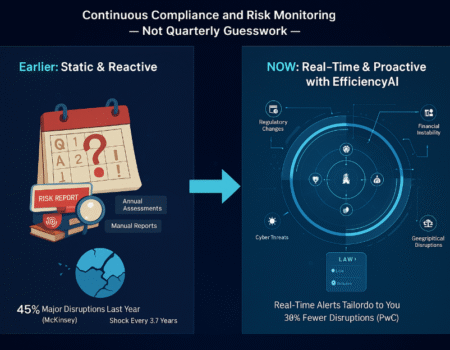
EfficiencyAI transforms the risk landscape by scanning continuously for signals such as:
| Regulatory or sanctions changes |
| Financial instability indicators |
| Cyber threats and breach reports |
| Adverse media Activity |
| Geopolitical or regional disruptions |
Now procurement receives real-time alerts tailored to their supplier system instead of discovering issues after they escalate.
Performance Management That Never Sleeps
Traditionally, supplier performance took place quarterly. Organizations downloaded spreadsheets, compared KPIs, chased stakeholders for reviews, and always identified problems too late.
EfficiencyAI collapses this entire cycle.
Now, systems can update scorecards automatically as data flows in from delivery logs, quality reports, invoice systems, and external risk feeds. There are also early-warning notifications that flag underperformance even before they become visible manually. Corrective action workflows initiate themselves with predefined logic.
Companies that adopt AI-powered performance management report:
- 30–50% faster issue resolution
- 40% fewer quality-related escalations
- 20% higher supplier accountability
This is SRM in motion — not static documentation.
Automation That Frees Humans for Higher-Value Work
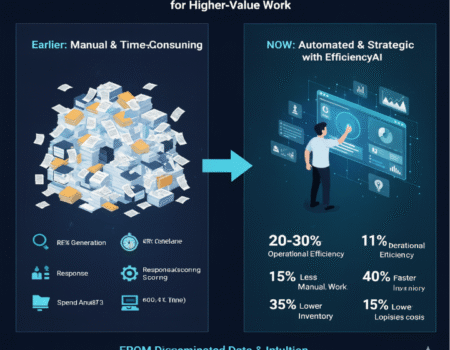
Across the procurement lifecycle, EfficiencyAI takes on tasks that once consumed hours each day.
RFx documents generate automatically using historical data.
Supplier responses are scored instantly with AI-backed logic.
Spend analysis, a task that typically drains 60–80% of analytics time, becomes real-time.
The Hackett Group reports that, organizations using AI and automation in procurement achieve:
- 20–30% operational efficiency gains
- 15% reduction in manual workloads
- 40% faster response time to supplier inquiries
- 35% lower inventory levels through improved forecasting
- Up to 15% reduction in logistics costs
But speed isn’t the most important benefit. It is clarity.
Finally, procurement leaders have the input to make evidence-driven decisions instead of depending on disseminated data and intuition.
A New Era of Supplier Engagement
Now that the administrative load has been lifted, supplier engagement has become more strategic.
Certificate renewal dates, PO status updates, portal instructions make up nearly 60% of supplier inquiries globally. However, AI-powered messaging tools handle routine questions today. Because of this, procurement teams get time to focus on innovation meetings, category strategy, supplier development, and exploring new business models.
The True Story: AI Does Not Replace SRM — It Expands It
The fear used to be that AI would eliminate the human side of SRM.
EfficiencyAI amplifies human capability. It removes the manual noise that has always pulled procurement away from strategic priorities. With AI, professionals can operate with foresight.
When SRM meets Gainfront EfficiencyAI, supplier management becomes faster, and inherently smarter. Organizations move from maintaining relationships to optimizing them. Now, procurement changes from a cost center into a strategic and intelligence-driven function.
This new narrative directs how companies build, nurture, and grow their supplier ecosystems in a world where certainty is no longer guaranteed.