Your legal team negotiated favorable pricing. The contract is signed. The supplier agreed to delivery timelines. Compliance clauses are in place, properly reviewed, properly filed.
Six months later, a different picture has emerged. Teams are buying off-contract because the approved channel was slower than the workaround. A renewal date passed without anyone noticing, and pricing reverted to standard rates. Supplier delivery performance has quietly declined, but nobody’s been tracking it against the SLA that’s sitting in the contract. Procurement is spending more time chasing exceptions than it spent negotiating the original deal.
The contract didn’t fail. It did exactly what contracts do — it documented an agreement. The problem is the assumption that documenting an agreement is the same thing as ensuring it happens.
Contracts define obligations. They don’t execute them.
What Contract Lifecycle Management Actually Does
Contract Lifecycle Management (CLM) covers the process of creating, reviewing, negotiating, approving, executing, storing, and renewing contracts. Modern CLM platforms have gotten genuinely good at this: templated drafting, redlining and negotiation tracking, approval routing, searchable storage, and renewal date tracking.
That’s real value. Before CLM software, contracts lived in shared drives with inconsistent naming, approval happened over email threads that disappeared into inboxes, and renewal dates were tracked — if they were tracked — manually.
What CLM platforms manage is the contract as a document and an approval record. What they don’t manage, by design, is what happens after the contract is signed and the actual procurement relationship begins.
Why Contracts Alone Don’t Create Procurement Control
A contract is static. It’s a snapshot of an agreement at a point in time. Procurement is dynamic — it’s an ongoing, continuously changing set of activities: purchasing decisions made daily, supplier performance that fluctuates, market conditions that shift, internal teams making buying choices in real time.
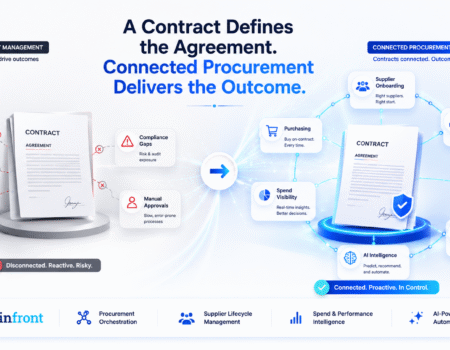
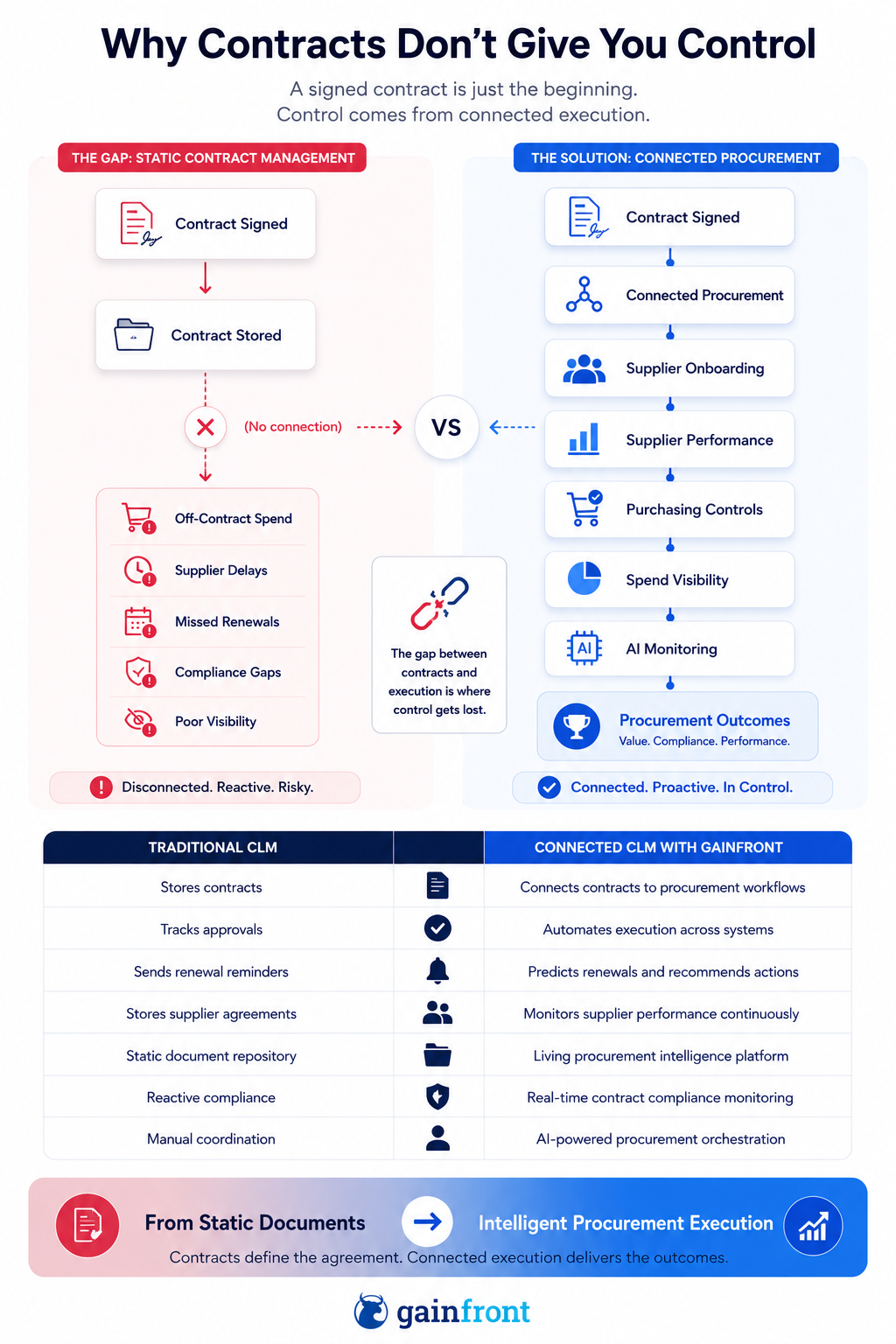
The gap between those two things — a static document and a dynamic operation — is where control gets lost. Execution depends on people knowing what the contract says, systems enforcing it at the point of purchase, suppliers actually meeting what they agreed to, workflows routing transactions through the right channels, and approvals happening fast enough that nobody has reason to work around them.
A signed contract influences none of that automatically. It only works if every downstream system and process actually references it.
Five Reasons Enterprises Lose Control After Signing a Contract
1. Contracts Aren’t Connected to Daily Procurement Workflows
This is the most common failure, and it’s structural rather than behavioral. Employees who need to buy something check what’s fastest, not what’s contracted — unless the system makes the contracted path the fastest one.
When it isn’t, the result is predictable: maverick spend, manually created purchase orders that bypass the systems where contract terms live, decentralized purchasing across departments that never check what’s already been negotiated.
Why does contract leakage happen?
It happens when the contracted price or terms exist in a system that purchasing activity doesn’t pass through. The agreement is real. It’s just disconnected from the moment where buying decisions actually get made.
2. Supplier Performance Isn’t Linked to Contract Commitments
Contracts define SLAs — delivery windows, quality standards, response times, service levels. Very few organizations measure performance against those commitments continuously. Instead, performance gets reviewed quarterly, if at all, often disconnected from the specific terms that were negotiated.
A supplier missing delivery commitments for three months running is a contract compliance issue. But if nobody’s tracking delivery performance against the SLA in the signed agreement, that pattern shows up as “this supplier has been a little slow lately” instead of “this supplier is in breach of a measurable, contracted commitment.”
How does supplier performance affect contract compliance?
Directly — but only if performance data is actually compared against contracted terms in something close to real time. Otherwise the contract sets a standard that nothing is actively checking the supplier against.
3. Contract Obligations Become Invisible Over Time
A contract signed eighteen months ago contains commitments that were front of mind at signing and have since faded from anyone’s attention. Renewal dates approach without triggering review. Pricing tiers that were negotiated based on volume thresholds go unused because nobody’s tracking whether the threshold was hit. Rebates that were part of the deal go uncollected because no one’s monitoring eligibility.
Why do enterprises miss contract renewals?
Usually because the renewal date exists in the CLM system but nothing connects that date to the people who need to act on it with enough lead time. A renewal reminder thirty days out is often too late to renegotiate meaningfully — the leverage was at ninety days, when alternatives could still be evaluated.
4. Procurement, Legal, Finance, and Suppliers Work in Different Systems
The typical enterprise stack: an ERP for purchasing, a CLM for contracts, a separate system (or none) for supplier performance, supplier portals that suppliers update independently, an AP system for payments, and email and spreadsheets filling whatever gaps the formal systems leave.
The contract exists in one system. The work happens somewhere else.
Why are procurement systems disconnected?
Mostly because they were bought to solve specific point problems at different times by different teams, without a shared data model connecting them. Each system is good at what it does. None of them was built assuming the others exist.
5. AI Cannot Manage Contracts Without Context
This is the one most relevant to where procurement technology is heading in 2026, and it’s frequently underestimated.
AI applied to contracts needs more than the contract document. To generate useful recommendations, it needs supplier performance history, risk signals, spend data, purchasing activity, and onboarding records connected to that contract. A PDF with negotiated terms, read in isolation, tells an AI system what was promised. It tells it nothing about what’s actually happening.
How does AI improve Contract Lifecycle Management?
When connected to live procurement data, AI can extract obligations, flag compliance gaps, compare clauses across the portfolio, and surface renewal opportunities with real lead time. Without that connection, it can summarize a document — which is useful, but a fraction of what’s actually needed.
What Procurement Leaders Need Instead of Standalone CLM
The gap above points toward a different architecture: not a better contract repository, but connected procurement — where contract data, supplier lifecycle data, spend visibility, supplier risk monitoring, purchasing workflows, and AI-driven automation share a common data layer instead of operating as separate tools.
In that model, a contract isn’t a document that gets filed and referenced occasionally. It’s an active input into supplier onboarding, into the purchasing workflow that determines which channel a transaction routes through, into the performance monitoring that checks suppliers against what they agreed to, and into the renewal process that has enough lead time to actually negotiate.
The Shift From Contract Management to Contract Intelligence
Traditional CLM stores contracts, tracks approvals, and manages document versions. That’s necessary infrastructure. It’s not sufficient for control.
Contract intelligence is a different capability: continuous monitoring of supplier performance against contracted terms, real-time compliance tracking at the point of purchase, spend analysis that flags when transactions fall outside negotiated pricing, obligation tracking that surfaces commitments with enough lead time to act, and renewal management that starts the evaluation process while there’s still leverage to use.
The difference matters more in 2026 than it did five years ago, because the cost of disconnection has gotten more visible. Supply chain volatility, tighter margins, and increasing compliance complexity all raise the cost of contract terms that exist on paper but aren’t being enforced in practice.
How AI Changes Contract Lifecycle Management
AI’s practical contributions to CLM are concrete:
Contract summarization — condensing lengthy agreements into the terms that matter for a specific question, without requiring someone to read the full document every time.
Obligation extraction — automatically identifying commitments, deadlines, and conditions buried in contract language, so they’re tracked systematically rather than depending on someone remembering to flag them.
Renewal reminders with actual lead time — surfacing upcoming renewals early enough that there’s time to evaluate alternatives or renegotiate, not just a notification the week before the deadline.
Clause comparison across the portfolio — identifying inconsistent terms, unfavorable language, or missing protections by comparing language across hundreds or thousands of contracts at once.
Risk identification — flagging contracts with concerning terms, expired compliance requirements, or counterparties showing financial distress signals.
Compliance monitoring — checking whether actual purchasing activity is staying within contracted terms, rather than discovering deviations during an annual audit.
Approval recommendations — suggesting routing and approval paths based on contract value, risk profile, and historical patterns, reducing the manual triage that slows contract cycles.
All of this depends on the AI having access to data beyond the contract document itself. A clause comparison tool working only from PDFs can compare language. It can’t tell you whether the supplier whose contract it’s analyzing is actually performing — that requires connection to supplier performance data, spend data, and risk monitoring that lives outside the CLM platform entirely.
Frequently Asked Questions
What is Contract Lifecycle Management?
The process of creating, reviewing, negotiating, approving, executing, storing, and renewing contracts. CLM platforms manage the contract as a document and an approval workflow — drafting, redlining, e-signature, storage, and renewal tracking.
Why is CLM important?
It creates structure and accountability around how agreements get made and documented. Without it, contracts live in inconsistent formats across shared drives, approvals happen over untracked email threads, and renewal dates get missed because nothing is systematically tracking them.
Why do contracts fail to improve procurement?
Because a signed contract doesn’t automatically influence the systems and workflows where actual purchasing happens. Unless contract terms are connected to purchasing channels, supplier performance monitoring, and renewal processes, the agreement exists separately from the procurement activity it was meant to govern.
What is contract leakage?
The gap between negotiated contract terms and what actually happens in practice — purchasing at non-contracted prices, buying from non-approved vendors, or missing rebates and volume discounts because nobody is tracking eligibility against the contract.
How does AI improve contract management?
By extracting obligations automatically, flagging compliance gaps, comparing clauses across a contract portfolio, and surfacing renewal opportunities with enough lead time to act. AI’s value scales significantly when it has access to supplier performance and spend data beyond the contract text itself.
What is the difference between CLM and Supplier Lifecycle Management?
CLM manages the contract as a document — drafting, approval, storage, renewal. Supplier Lifecycle Management manages the full supplier relationship — onboarding, qualification, performance monitoring, risk assessment, and compliance over time. SLM is what gives contract terms an active connection to what’s actually happening with the supplier.
Why do enterprises miss contract renewals?
Because renewal dates often exist only in the CLM system without a connected process that alerts the right people with enough lead time to actually act — evaluate alternatives, renegotiate terms, or assess whether the relationship should continue.
What is procurement orchestration?
The connection of sourcing, contract management, supplier data, purchasing workflows, and accounts payable into a unified process, rather than managing each as an isolated system. Orchestration is what allows a contract’s terms to actually govern purchasing behavior in real time.
How does supplier performance impact contracts?
Contracts typically define SLAs — delivery timelines, quality standards, response times. Supplier performance data shows whether those commitments are being met. Without continuously comparing performance against contracted terms, a contract’s compliance provisions are aspirational rather than enforced.
What is contract compliance?
The degree to which actual purchasing activity and supplier behavior align with the terms specified in a signed contract. Measuring it requires connecting transaction data, supplier performance data, and contract terms — something that doesn’t happen automatically just because a contract was signed.
Can AI automate contract management?
AI can automate significant portions: obligation extraction, summarization, clause comparison, renewal alerts, and approval routing. Full automation of contract decisions still requires human judgment for negotiation and complex terms, but AI substantially reduces the manual work around tracking and monitoring.
Why is contract visibility important?
Because contracts that aren’t visible to the people executing procurement activity can’t influence behavior. If a buyer doesn’t know a contract exists for a category, or a finance team can’t easily check pricing against an agreement, the contract’s terms exist on paper without affecting what actually happens.
How do procurement and legal teams collaborate effectively on contracts?
By working from a shared, connected system rather than handing documents back and forth between disconnected tools. When contract data, supplier data, and procurement workflows share a common platform, legal’s negotiated terms become directly actionable for procurement rather than requiring manual translation.
How does CLM reduce procurement risk?
By creating documented, approved terms that establish accountability and provide a basis for resolving disputes. CLM alone reduces risk associated with contract creation and approval. Reducing risk associated with contract execution requires connecting CLM to supplier performance monitoring and purchasing controls.
Conclusion: Contracts Need Connected Execution
Contracts create accountability. They don’t create results on their own.
The enterprises getting real value from their contract investments are connecting contracts to supplier onboarding, supplier performance monitoring, procurement workflows, purchasing systems, spend visibility, and AI-driven automation. That’s what moves an organization from managing contracts as documents to actively controlling the procurement outcomes those contracts were supposed to guarantee.
How Gainfront Helps
Gainfront extends the value of traditional Contract Lifecycle Management by connecting contracts to the rest of the procurement ecosystem.
Through its integrated Supplier Lifecycle Management (SLM) platform and AgentFlow™ procurement orchestration capabilities, organizations can link contracts to supplier onboarding and qualification, monitor supplier performance against contractual commitments, improve contract compliance through automated workflows, reduce contract leakage with purchasing controls, and get real-time visibility into spend, supplier risk, and outstanding obligations. AI surfaces insights, automates approvals, and manages renewals proactively rather than reactively.
Instead of treating contracts as static documents, Gainfront helps turn them into active, data-connected components of procurement operations — supporting better compliance, stronger supplier relationships, and outcomes that are actually measurable. Learn more at gainfront.com.