
Your Systems Are Overspending, Not Your Team
Disconnected systems, manual approvals, and poor supplier visibility drive procurement costs more than bad buying decisions.

Founder & Chief Executive Officer
- Published

Here’s a frustrating pattern that shows up across enterprise procurement: the company has an ERP. It has a sourcing platform. It has a supplier portal. It has a contract management tool. Sometimes it has all four, plus a few spreadsheets running alongside them for the things the other systems don’t quite cover.
And procurement costs keep rising anyway.
The budget conversations get uncomfortable. Someone proposes cutting supplier count or squeezing margins. The procurement team pushes back because they know that’s not where the waste actually lives. But they can’t always point to exactly where it does.
That’s the problem. In 2026, most enterprise procurement isn’t bleeding because of bad people or wrong strategy. It’s bleeding because of friction: between systems that don’t talk to each other, workflows that require manual handoffs to move, and supplier data scattered across tools that were never designed to integrate.
Procurement disruptions are costing enterprises millions annually. Supply chain volatility and rising logistics costs continue to pressure procurement teams. None of that is going away. But a meaningful portion of procurement cost isn’t external pressure: it’s internal drag that the right architecture removes.
Why Procurement Costs Keep Rising Even After Software Investment
Disconnected Systems Are the Actual Problem
Procurement teams don’t lack software. They lack coordination between the software they have.
An approval sits in one system. The supplier record is in another. The contract terms are in a third. The delivery performance data is somewhere in the ERP, if someone pulls the report. When a buyer needs to make a sourcing decision, they’re triangulating across four systems to assemble a picture that should be one screen.
That coordination tax is real. It shows up as slower cycle times, more errors, more manual reconciliation work, and procurement professionals spending time on data assembly instead of decisions.
Manual Workflows Create Cost in Ways That Don’t Appear in Invoices
A purchase requisition that takes four days to approve because it’s moving through email chains isn’t free. The delay has a downstream cost: in production timelines, in expedited shipping required to recover the lost time, in the operational disruption of the team waiting on the PO.
Invoice reconciliation done manually creates the same problem at the back end. Disputes, delays in payment, relationship friction with suppliers that could otherwise be strategic partners. None of this appears as a line item, but it accumulates.
Poor Supplier Visibility Hides Inefficiency Until It’s Expensive
When procurement teams don’t have consolidated visibility into supplier performance, duplicate suppliers survive longer than they should. Underperforming vendors get renewed by default. High-defect suppliers keep getting business because no one has the data assembled to make the case for switching.
Supplier visibility gaps also mean that delivery problems get discovered when something doesn’t arrive, not when the pattern that predicted the miss first showed up. That’s a reactive posture, and reactive posture in procurement means paying expedited freight rates instead of managing a situation before it requires expediting.
Maverick Spending Is Often Larger Than It Looks
Maverick spending: purchases made outside contracted channels, with non-approved vendors, or off established pricing agreements: is consistently underreported because it’s hard to track without unified spend visibility. When different departments are buying independently, off-contract purchasing adds up quickly and quietly.
The problem isn’t that people are trying to break procurement rules. It’s that the rules are hard to follow when the approved channels are cumbersome and the data on what’s contracted isn’t easily accessible at point of purchase.
Reactive Supplier Management Generates Cost Through Disruption
Supplier problems that aren’t caught early become expensive emergencies. Emergency sourcing at spot prices, expedited logistics to fill gaps, production slowdowns while alternatives are qualified: all of these are more costly than the monitoring program that would have flagged the problem two weeks earlier.
Poor supplier visibility remains one of the biggest procurement challenges for enterprises globally. The cost isn’t just operational. It’s the compounding effect of every reactive response across a supplier base of any size.
The Hidden Costs Most Procurement Teams Can’t Easily Quantify
The biggest procurement costs rarely appear in the invoice itself.
Approval delays create downstream scheduling problems that require expediting to fix. The expediting cost shows up. The approval delay that caused it usually doesn’t.
Contract leakage, the difference between contracted pricing and what’s actually being paid across transactions: is often invisible without automated reconciliation. In large organizations, this can be substantial.
Duplicate vendors cost money twice: once in the administrative overhead of managing them, and again in the missed volume consolidation that would have produced better pricing.
Inventory inefficiency driven by poor demand forecasting or unreliable supplier lead times ties up working capital that could be deployed elsewhere.
Manual reconciliation generates labor cost and error cost in roughly equal measure. Every invoice that has to be manually matched, disputed, or corrected represents time and money that automated matching would have saved.
Procurement cycle drag, the cumulative time added to purchasing processes by manual approvals, system-switching, and data re-entry: slows the business and adds cost to every transaction that flows through it.
Procurement Cost Reduction Strategies That Actually Work
Centralize Supplier Data
The starting point for most other improvements. When supplier information: performance history, contract terms, compliance status, financial health, delivery records: lives in one place and stays current, procurement decisions get better and faster.
Centralized supplier data also makes it possible to spot things that fragmented systems hide: duplicate vendors serving the same function, concentration risk from relying too heavily on a single supplier for a critical input, performance trends that predict problems before they hit.
Automate the Workflow Overhead
Procurement automation in 2026 is less about replacing headcount and more about eliminating coordination friction. Automated approval routing, purchase requisition workflows, PO generation, and invoice matching each remove manual steps that slow processes and introduce errors.
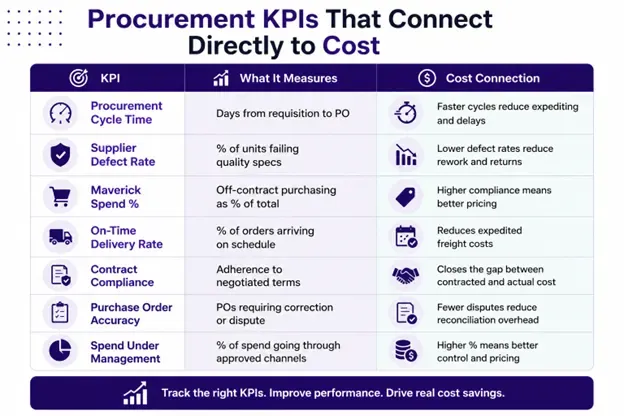
The business case is usually straightforward. Procurement cycle time is a KPI with a direct cost connection: every day shaved off average approval time across thousands of transactions per year adds up. AI-driven procurement systems are increasingly used to optimize sourcing, identify inefficiencies, and reduce procurement cycle time.
Build Real Spend Visibility
You can’t control what you can’t see. Spend visibility: understanding by category, supplier, department, and contract how money is actually being spent: is the foundation for any serious cost reduction program.
Real-time spend dashboards change the conversation. Instead of discovering in a quarterly review that a department has been buying off-contract for three months, procurement teams see the pattern as it develops and can intervene early.
Use Supplier Performance Analytics Proactively
Supplier scorecards have been around for a long time. The difference in 2026 is that the best procurement teams aren’t reviewing them quarterly: they’re running continuous monitoring that surfaces performance changes as they happen.
A supplier whose on-time delivery rate starts dropping in February is manageable. The same supplier three months later, after production has been disrupted twice and the relationship has become adversarial, is expensive. The data was there. The question is whether the system surfaced it in time to act.
Reduce Supplier Risk Before It Creates Cost
Risk reduction and cost reduction are the same conversation. A supplier that fails creates emergency sourcing costs. A financially weak supplier that gets renewed because no one ran the financial health check creates a future disruption. Proactive risk monitoring: financial health signals, delivery trends, compliance status, geopolitical exposure: removes costs before they exist rather than containing them after.
Use AI for the Work That Doesn’t Require Human Judgment
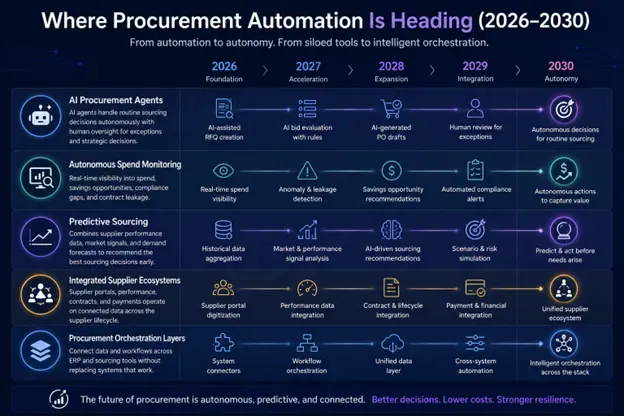
Anomaly detection in spend data. Automated compliance checks. Predictive alerts on supplier risk. Intelligent sourcing recommendations based on performance and cost history. These are tasks that AI handles better and faster than manual processes, and they free procurement professionals for the decisions that actually require human judgment: negotiation, relationship management, strategic sourcing.
Traditional Procurement vs. Intelligent Procurement
| Traditional Procurement | Intelligent Procurement |
|---|---|
| Manual approvals via email | Automated approval workflows |
| Siloed ERP, sourcing, CLM systems | Connected procurement stack |
| Reactive supplier management | Predictive supplier intelligence |
| Spreadsheet-based reporting | Real-time spend dashboards |
| Quarterly performance reviews | Continuous monitoring |
| Fragmented supplier records | Centralized supplier intelligence |
| Spot-check compliance audits | Automated compliance tracking |
| Slow, high-friction cycles | AI-assisted automation throughout |
The gap between these columns is where most of the hidden cost lives.
What High-Performing Procurement Teams Actually Do
There’s a set of practices that shows up consistently in procurement teams with low cost leakage and high supplier reliability:
They have one version of supplier truth. Supplier data isn’t scattered: it’s consolidated, current, and accessible to anyone who needs it. Performance metrics, compliance status, contract terms, and financial health are all in the same place.
They manage by exception, not by manual review. Automated monitoring flags problems. The procurement team investigates and decides. They’re not spending time assembling data: they’re acting on it.
They treat spend visibility as non-negotiable. Not quarterly reports. Actual real-time visibility into what’s being spent, where, with whom, and whether it’s on contract.
They close the loop between sourcing and performance. The supplier chosen in a sourcing event gets tracked against the performance expectations that justified the selection. That data feeds back into the next sourcing decision.
They have a plan before emergencies happen. Alternative suppliers are identified and partially qualified before they’re needed. When a primary supplier has a problem, the response is a decision, not a scramble.
FAQ
How do companies reduce procurement costs?
By eliminating the friction that creates hidden cost: disconnected systems, manual workflows, poor supplier visibility, and reactive supplier management. Cost reduction isn’t primarily about cutting suppliers or squeezing prices: it’s about removing the operational drag that makes procurement more expensive than it needs to be.
What increases procurement costs?
Fragmented systems that require manual data assembly, approval workflows running through email, maverick spending outside contracted channels, supplier performance problems that go undetected until they cause disruptions, and poor spend visibility that makes contract leakage invisible.
What are the biggest procurement inefficiencies?
Manual approval workflows, duplicate vendors surviving because no one has consolidated the data to spot them, off-contract buying that accumulates without visibility, and reactive supplier management that pays emergency prices to address problems that could have been caught early.
How does procurement automation reduce costs?
By removing the manual steps that slow cycles and introduce errors. Automated approvals reduce cycle time. Automated invoice matching reduces reconciliation cost and disputes. Automated compliance checks surface off-contract spending before it compounds. Each eliminates overhead that adds cost without adding value.
What is procurement cost reduction?
Reducing the total cost of procurement operations, not just supplier prices, but the internal cost of running the process, the cost of disruptions from supplier failures, and the cost of the working capital tied up by inventory inefficiency and approval delays.
How does supplier visibility reduce procurement costs?
It catches problems before they become expensive. A supplier whose delivery performance is degrading is manageable if you see it early. The same trend caught after it causes a production disruption means expedited freight, emergency sourcing, and the operational cost of the delay.
What is spend visibility in procurement?
Real-time understanding of what’s being spent, where, with which suppliers, and whether it’s on contract. It’s the baseline for any serious cost control program. Without it, contract leakage and maverick spending accumulate invisibly.
How does AI improve procurement efficiency?
By handling the monitoring and data work that currently consumes procurement team time: anomaly detection in spend, automated compliance checking, supplier risk monitoring, and predictive alerts. This lets procurement professionals focus on decisions that require judgment rather than data assembly.
Why do disconnected systems increase procurement costs?
Because coordination between systems takes time and creates errors. A buyer who needs to check four systems to make one sourcing decision is slower, more error-prone, and more likely to skip steps. The coordination cost compounds across thousands of transactions.
What are procurement KPIs that impact cost savings?
Procurement cycle time, supplier defect rate, maverick spend percentage, on-time delivery rate, contract compliance rate, PO accuracy, and spend under management. Each connects to a specific cost mechanism.
What is maverick spending?
Purchasing made outside approved channels, with non-contracted vendors, or at off-contract pricing. It typically happens when approved procurement channels are slower or more cumbersome than the alternatives. Spend visibility is what makes it detectable, and simpler approved channels are what reduce it.
How does procurement orchestration work?
It connects data and workflows across existing procurement systems. ERP, sourcing, CLM, supplier portals, without replacing them. The orchestration layer creates a unified view of supplier data and automates handoffs between systems, removing the manual coordination that slows procurement and creates errors.
How can enterprises improve procurement efficiency?
By centralizing supplier data, automating routine workflow steps, building real spend visibility, monitoring supplier performance continuously rather than periodically, and using AI for the monitoring and detection work that doesn’t require human judgment.
What is the future of procurement automation?
Autonomous agents handling routine sourcing and compliance decisions, predictive monitoring surfacing problems and opportunities before procurement teams have to go looking for them, and procurement orchestration layers that make existing system investments work together rather than in parallel.
Why is procurement becoming more expensive?
A combination of external pressure: logistics costs, tariffs, geopolitical disruption, supplier financial fragility, and internal drag from systems and processes that weren’t designed to work together at the current pace and complexity. The external factors are largely unavoidable. The internal drag is the addressable portion.
Gainfront’s procurement intelligence platform connects supplier data, spend visibility, and workflow automation in a single orchestration layer, so procurement teams can see what’s happening, act faster, and spend less time assembling information from systems that don’t talk to each other. See how it works at gainfront.com.