
Best AI Agents for Procurement in 2026
How AI agents for procurement find savings: normalization that unlocks volume discounts, and 16,000-category data that drives budgets, forecasts and exclusions.

Founder & Chief Executive Officer
- Published
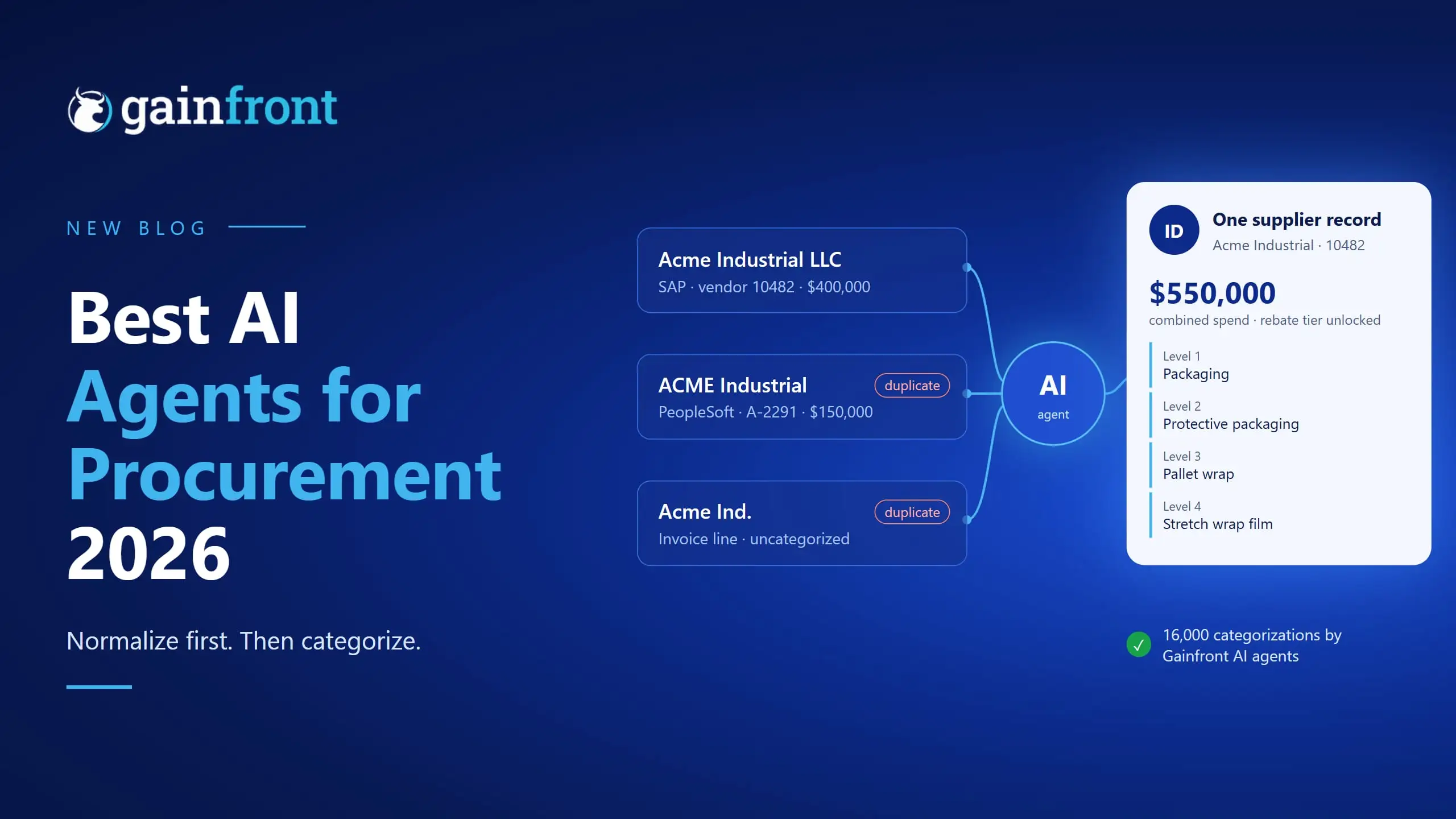
The best AI agents for procurement in 2026 do two data jobs before they do anything else. First they normalize your suppliers, merging every version of the same company into a single source of truth, which is where missed volume discounts and rebates turn up. Then they categorize your spend four levels deep, which is what makes budgets, forecasts, and diversity reporting accurate. Gainfront’s AI agents do both on one supplier record, against 16,000+ normalized categories, without an IT project. Zip, Coupa, SAP, Ivalua, Fairmarkit, and GEP all ship capable agents too, and we compare them below. The question that separates them is what each agent writes to.
Every procurement vendor now has a named agent catalog, and those names are showing up in 2026 RFPs. This page compares the agents, not the launch announcements. Gainfront wrote it, and we build in this category, so every competitor claim below is attributed to that vendor’s own public material, checked on 23 November 2026. Apply the same tests to us.
What does an AI agent in procurement actually do?
A copilot helps a person write or read something: it summarizes a supplier, drafts an email, or suggests contract wording. An agent does the next step itself, within rules you set. It calls a system, updates a record, launches an event, or routes an exception. Gartner draws the same line: an AI agent does a bounded task on its own or with some help, and “agentic AI” coordinates several agents across a wider workflow.
Describe the job, not the interface:
| Job | What the agent does | Where a person still signs off |
|---|---|---|
| Supplier normalization | Matches names, tax IDs, and sites across ERPs and merges duplicates into one supplier record | Merges that change who gets paid |
| Spend categorization | Assigns each line to a four-level category and maps alternate identifiers to a master commodity | Taxonomy policy changes and anything that changes a financial report |
| Intake triage | Reads the request, checks documents and supplier data, fills fields, routes it | Material exceptions, and anything that creates a financial commitment |
| Sourcing event | Builds the RFx, invites suppliers, collects and compares bids, recommends an award | Awards above your autonomy threshold and exceptions to sourcing policy |
| Risk watch | Monitors signals, attaches them to the right supplier, proposes mitigation | Suspension, termination, and contract changes |
| ERP / P2P write-back | Returns awards, prices, and supplier data to the system that pays | PO release and anything your delegation of authority reserves for a person |
The sign-off column is our recommendation, not a default every vendor enforces. Forrester’s October 2026 guidance says most procurement teams should expect augmentation before full autonomy, and Gartner warns of a gap between what agents can reliably do and what demos show. Write your approval gates into the RFP.
Notice the order. Normalization and categorization sit at the top because every job below them reads their output. An intake agent that routes a request to a duplicate supplier, or a sourcing agent that pools demand in the wrong category, is fast and wrong.
Normalization: one record of truth, and the savings it finds
Normalization answers a simple question: is this the same supplier? In most enterprises the answer is hidden. One business unit runs SAP and pays Acme Industrial LLC, vendor 10482. Another runs PeopleSoft and pays ACME Industrial, vendor A-2291. Different names, different IDs, no link. Every report treats them as two suppliers.
That split costs money. Say your contract with Acme pays a 2% rebate on all annual spend once it passes $500,000. SAP shows $400,000. PeopleSoft shows $150,000. Neither file crosses the threshold, so nobody claims the rebate. Merged, the total is $550,000, and Acme owes you $11,000.
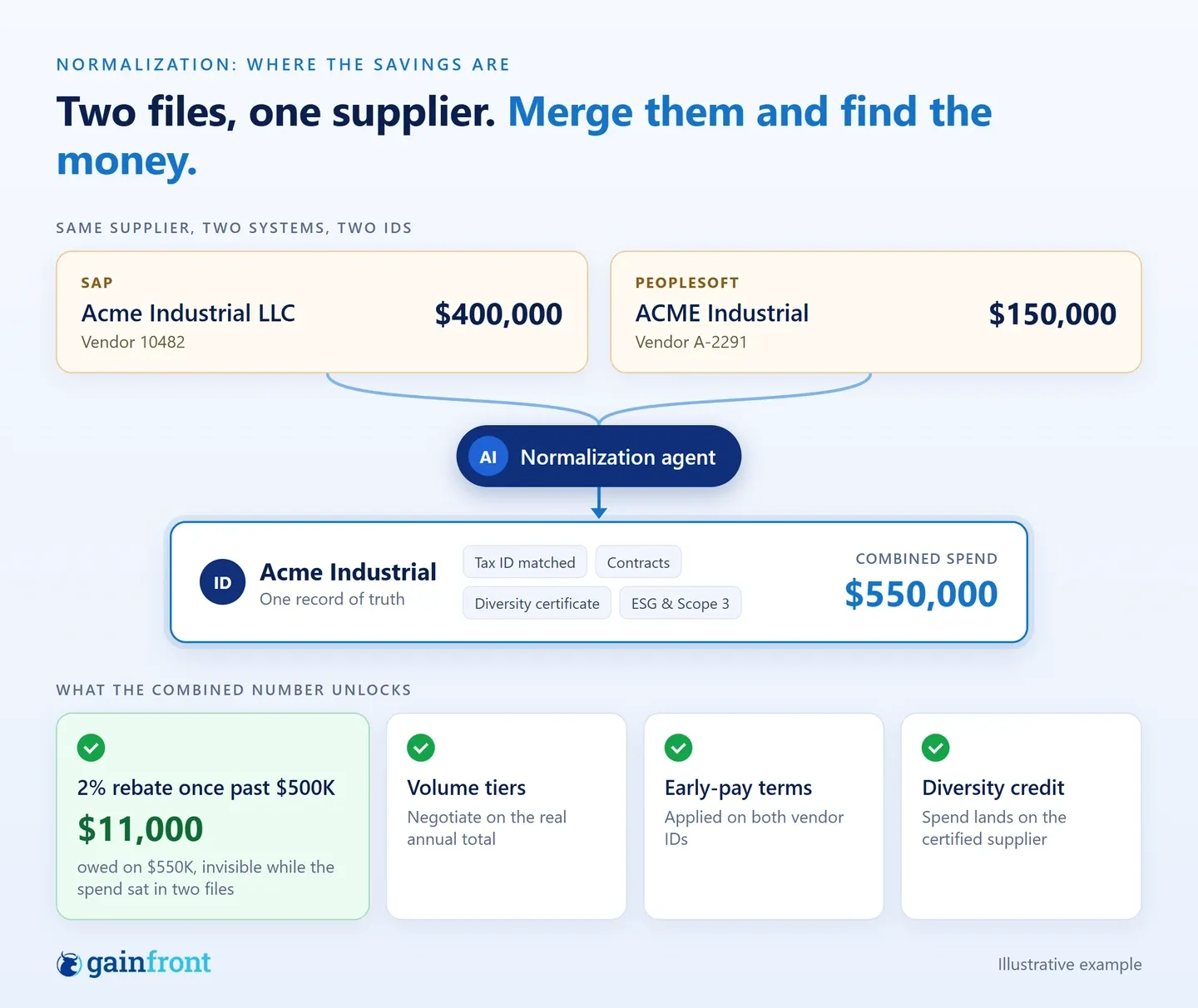
The rebate is the easiest number to explain, but the same split hides more:
- Volume tiers. You negotiate price on the spend you can see. If half of it sits under another name, you negotiate from the wrong number.
- Early-payment discounts. Terms set up on one vendor ID never reach invoices paid to the other.
- Supplier consolidation. You cannot move volume to your best-priced supplier if you do not know you are already buying the same thing from two.
- Diversity credit. If the certificate sits on one record and the spend on the other, certified spend goes uncounted.
How Gainfront’s agents normalize
Gainfront’s AI agents match suppliers on legal name, tax ID, address, and parent company, across every source you connect, and merge them into one record of truth. That record is not just a name. It carries the supplier’s contracts, risk, performance, diversity certificates, and sustainability data such as ESG and Scope 3 scores, so every team reads the same supplier.
The agents flag low-confidence matches for a person to review instead of merging them silently, because a wrong merge can change who gets paid. No model is 100% accurate, and none should act like it.
Customer results on that one record:
- National Fuel reached more than 98% accuracy in supplier data enrichment after Gainfront’s AI resolved duplicate records across onboarding, sourcing, and inclusion (case study).
- Thermo Fisher improved supplier data visibility by 90% and cut federal inclusion reporting from weeks to hours (case study).
- Travel + Leisure Co. cut supplier data processing time by more than half (case study).
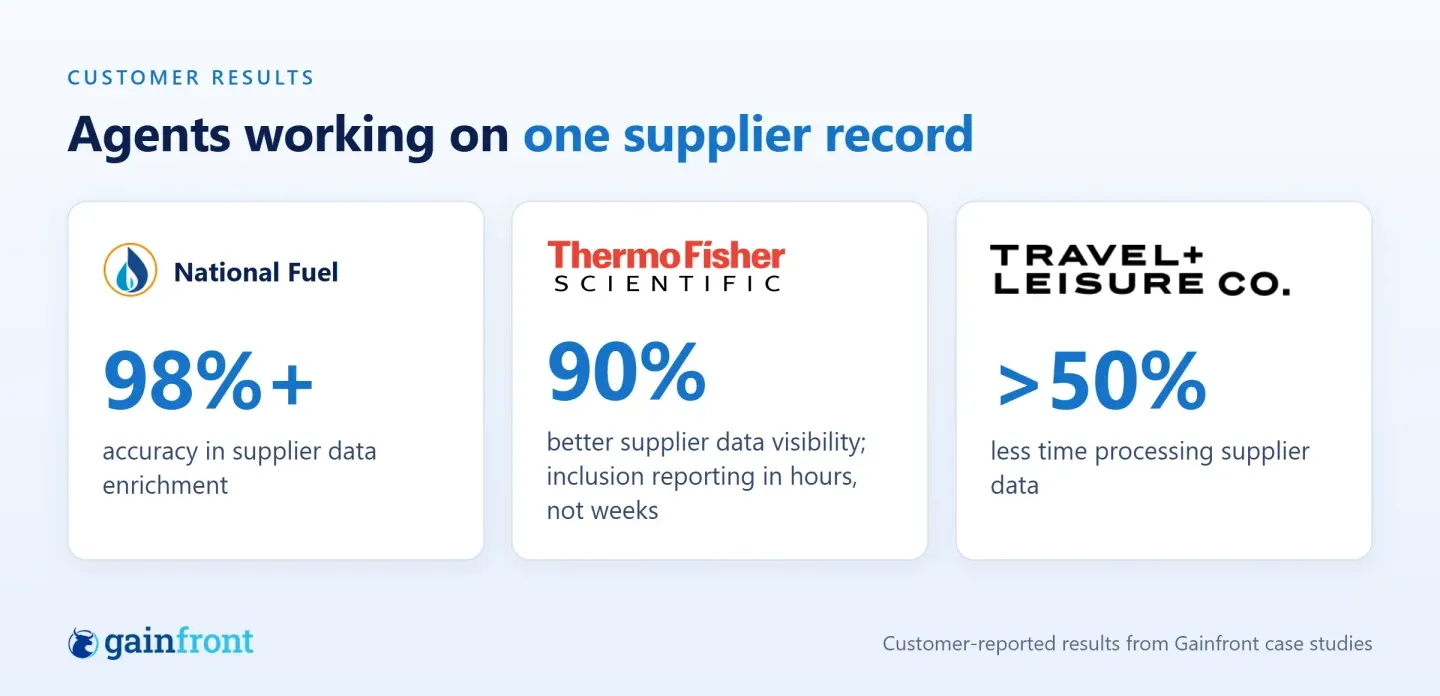
All of these are Gainfront and customer figures, not independent audits. Ask us to run the same test on your extract.
Categorization: four levels deep, for budgets, forecasts, and exclusions
Normalization tells you who the supplier is. Categorization tells you what you bought from them, and it is a different problem.
Most companies still lean on NAICS codes, the industry standard, because nothing better is on file. A NAICS code describes the supplier’s industry, not the purchase. Tag a supplier “marketing” and you have learned very little. Are you buying brand work, paid media, or search engine optimization?
A four-level taxonomy answers that. Level 1 is marketing. Level 2 is digital marketing. Level 3 is search marketing. Level 4 is SEO services. Search for an SEO supplier at level 1 and you get every marketing agency you have ever paid. Search at level 4 and you get the suppliers that actually do SEO.
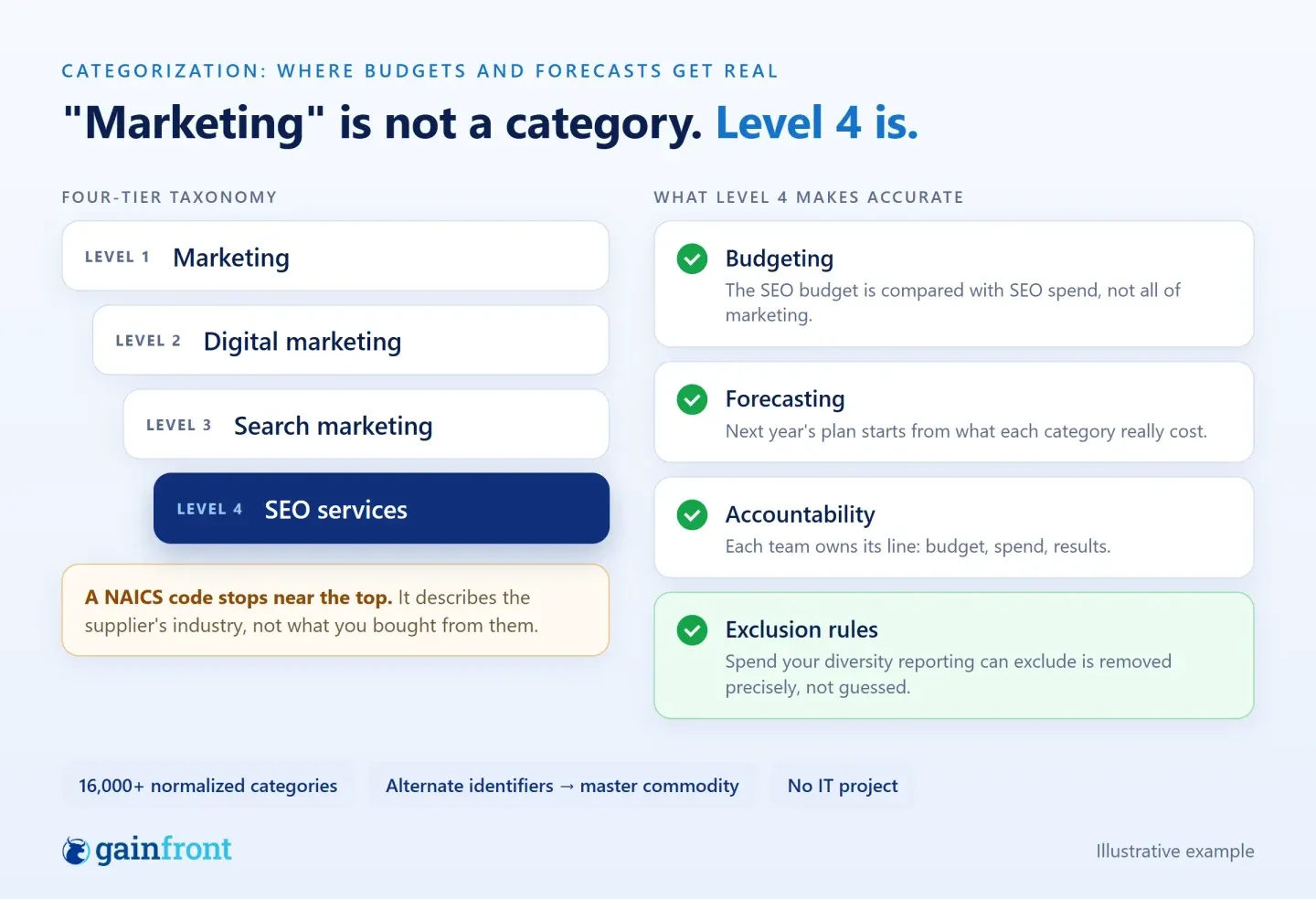
That precision is what makes the numbers usable:
- Budgeting. The SEO team’s budget is compared with SEO spend, not with everything clubbed under marketing. If SEO is over budget, you see it.
- Forecasting. Next year’s plan starts from what each category actually cost this year.
- Accountability. Each team owns its line: here is the budget, here is the spend, where are the results?
- Exclusion rules. Covered below. This is where categorization meets inclusion.
Alternate identifiers and the master commodity file
Categorization gets harder with direct materials, where the same item arrives under many names. Gainfront handles this with alternate identifiers: every name a commodity goes by, across ERPs, plants, and divisions, maps to one entry in a master commodity file. That file is built on Gainfront’s 16,000+ category taxonomy, and AI agents do the mapping, so your team reviews results instead of building crosswalks.
Here is what that looks like in Gainfront’s commodity report, in a demo environment with sample data. The master commodity is stretch wrap film. Division A buys it as “hand stretch film roll” ($336,000) and “machine pallet film” ($162,000). Division B buys it as “hand wrap 500mm × 300m” ($266,000) and “auto-wrap PE film” ($112,000). Four identifiers, two divisions, one commodity, and $876,000 of combined spend that no single report showed.
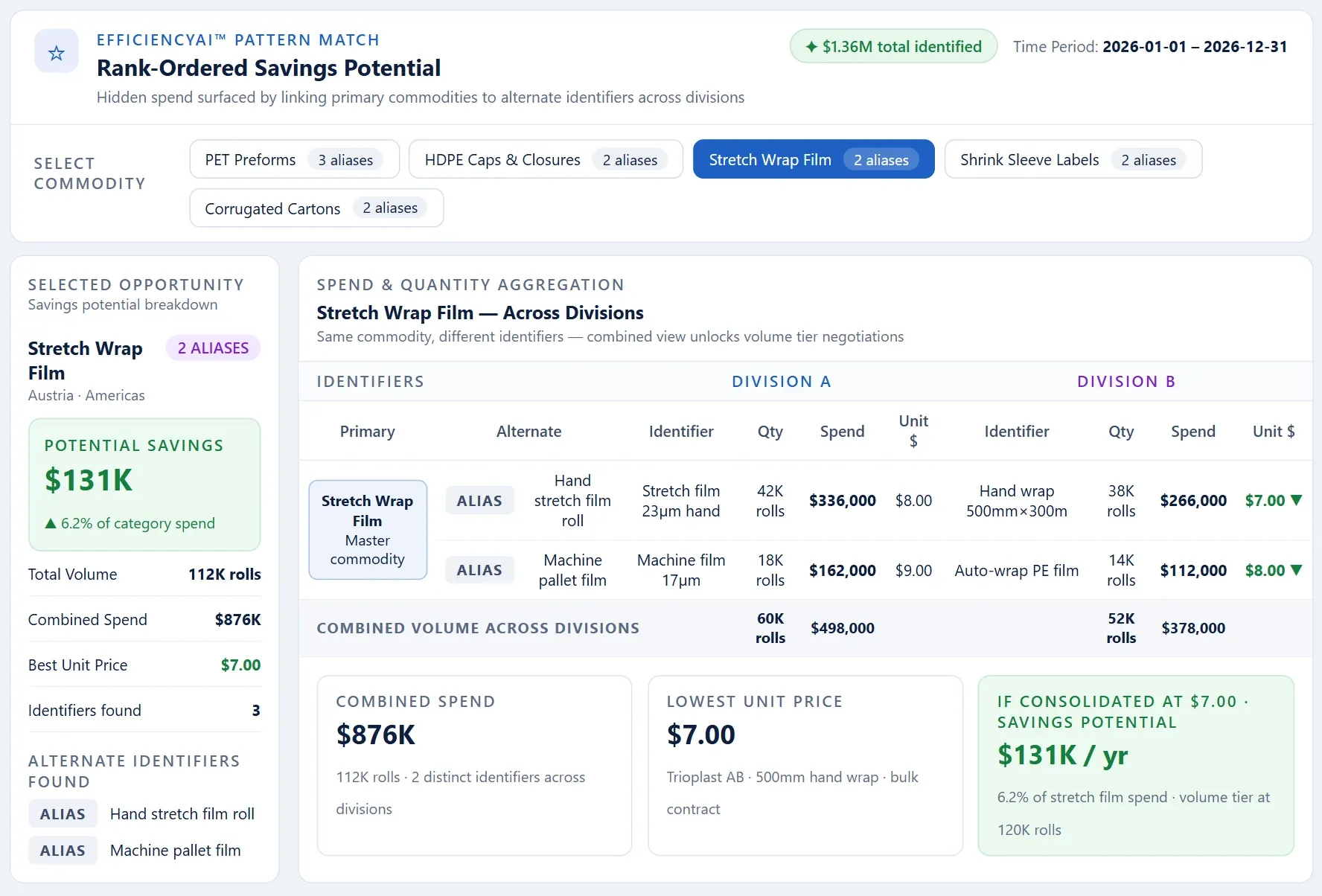
Once the spend sits under one master commodity, the agent can compare like with like. The same film costs between $7.00 and $9.00 a roll depending on which name it was bought under. The lowest price, $7.00, comes from Trioplast AB on a bulk contract, and a 10% volume tier starts at 120,000 rolls, just above the 112,000 rolls the two divisions buy between them. EfficiencyAI ranks the gap as a savings opportunity and estimates $131,000 a year if the volume is consolidated.
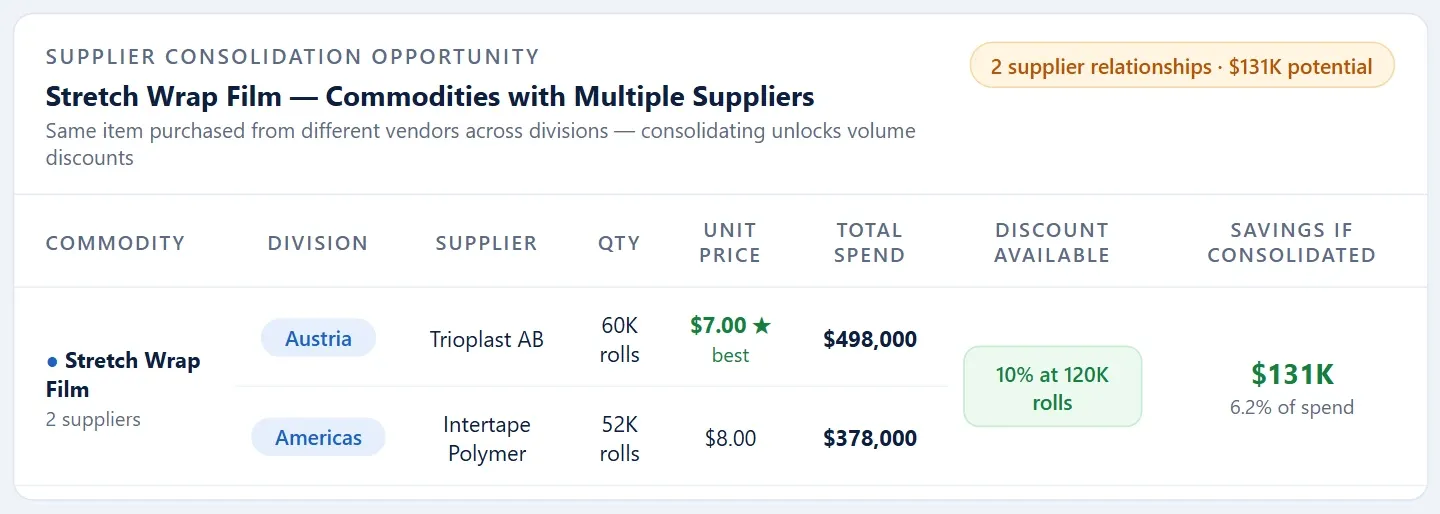
The agent does not move the volume. It shows the buyer the opportunity, the suppliers, and the math, and the buyer decides whether to call both suppliers in. That is the right division of labor: AI does the matching across thousands of lines that nobody has time to read, and a person makes the commercial call.
Exclusion rules: where categorization meets inclusion
Categorization also decides whether your diversity numbers are right. Companies that hold federal contracts report small and diverse business spend to the government as a share of total spend. Not every dollar belongs in that total. Your subcontracting plan can exclude spend that no small or diverse supplier could compete for, and exclusion rules remove it from the denominator.
Exclusion rules only work when categories are precise. If spend is tagged at level 1, the rule cannot tell an excludable purchase from an addressable one, so teams either exclude too little and understate their performance, or exclude too much and overstate it.
Merck is an example. Gainfront worked with Merck to review the types of spend associated with each supplier and identify the category codes that matched exclusions agreed to by the U.S. Small Business Administration (SBA). Gainfront then configured those codes so purchases in the identified categories were excluded from reported spend.
SBA reporting, automated
SBA small-business reporting is a federal requirement that procurement has to meet whatever the political climate. Most teams still build the report by hand, and the pain is always the same: the deadline arrives before the spreadsheet is done.
In Gainfront, SBA reporting is automated. Your team sets the small-business goals, exclusion rules run on the categorized spend, and Gainfront produces the report, so procurement meets the deadline instead of chasing it. Because excluded spend comes out of the base, the percentage you report reflects the spend that small businesses could actually compete for, and it usually goes up. Gainfront is the only procurement platform with SBA exclusion automation built in.
The results so far:
- $18 billion in spend exclusions identified for Gainfront customers using SBA-agreed category codes, increasing their SBA reporting percentage by 14%.
- 100% on-time submission of SBA reports.
The independent evidence points the same way. ISM’s October 2026 guidance says to set a governed taxonomy, normalize suppliers, and reconcile to ERP totals before adding predictive AI, and to track classification accuracy, supplier-resolution rate, unclassified spend, and reconciliation exceptions. APQC research found that consistent commodity coding is what makes spend analysis usable for finding consolidation and savings (the survey dates from 2024, but the point has not changed). A published Australian state-government case reports that 95% of AU$17 billion in spend was categorized, with AU$65 million in realized savings credited to better governance and less contract leakage. That case dates from 2023 and was written by the provider, but it shows the scale.
One warning for RFPs: accuracy percentages do not compare across vendors. A September 2026 study of more than 1.25 million public purchase lines found one classifier scored 56.0% on repeated item text and 31.9% on new text from the same dataset. A “95% accurate” claim on one corpus and an “85% accurate” claim on another tell you nothing until you know the test. Test on your own messy data.
Gainfront’s AI agents have completed 16,000 categorizations so far, and each one lands on the same supplier record that sourcing, risk, and diversity reporting read.
Which AI agents should be on your shortlist?
The table uses each vendor’s public material as of 23 November 2026. “Not published” means we could not find a precise answer, not that the capability is missing.
| Offering | Agent jobs (vendor’s description) | Which record the agent writes to | ERP / P2P write-back | Overlay or own suite |
|---|---|---|---|---|
| Gainfront: AgentFlow and EfficiencyAI | Normalization, categorization, intake, approvals, supplier discovery, RFx, contracts, risk, diversity | One Gainfront supplier record shared by onboarding, risk, performance, contracts, and inclusion | AgentFlow coordinates across existing S2P and ERP tools | Both: orchestrate or replace |
| Zip: agents and Superagents | Intake validation, routing, onboarding, sourcing, risk, contract workflows | Request and supplier records; authoritative master after classification not published | Integrations published; supplier-master semantics not published | Mainly overlay |
| Coupa: Compose and Navi | Requisition structuring, bid comparison, payment batches, agent building | Coupa spend and workflow data; destination of classification not published | Not published for this case | Coupa suite |
| SAP: Joule agents in Ariba | Intake, supplier classification, discovery, sourcing events, bid analysis, negotiation, risk | Ariba supplier, contract, and spend context | Native to SAP; third-party masters not published | SAP suite |
| Ivalua: IVA and IVA Studio | One agent across S2P: sourcing, supplier lookup, risk response, contract and PO retrieval | Ivalua S2P application data | MCP connectivity published; ERP-master write-back not published | Ivalua suite |
| Fairmarkit: Total Agentic Sourcing | Intake, supplier matching, sourcing events, evaluation | ERP / P2P stays authoritative | Yes: supplier data, prices, and awards sync back | Sourcing overlay |
| GEP: Quantum Intelligence | Sourcing, discovery, onboarding, spend analysis, diversity verification, risk, P2P, integration | GEP vendor master, with a harmonization agent for duplicates | GEP says agents read, write, and act across connected systems | Both |
Gainfront: AgentFlow and EfficiencyAI
Who it is for: mid-size and enterprise procurement teams whose ERP, risk, contracts, and diversity tools each hold a different version of the same supplier, and who want AI agents to fix that rather than copy it.
Gainfront’s agents work on the supplier record, not next to it. EfficiencyAI is built into the supplier lifecycle management suite: it normalizes suppliers, categorizes spend against 16,000+ categories, maps alternate identifiers to the master commodity file, and attaches the result to the supplier’s ID. Sourcing, risk, performance scorecards, and diversity reporting all read that same ID, so a savings number and a diversity number reconcile without a manual crosswalk.
AgentFlow is for teams that are keeping Coupa, Ariba, or their ERP. It coordinates intake, approvals, and supplier work across those tools, supports bring-your-own LLM, and brings Gainfront supplier context to each decision. When you are ready, you can add SLM modules one at a time instead of a big-bang cutover. An MCP server lets ChatGPT or Claude query the same supplier, contract, and spend data.
Where it is strong: normalization and four-level categorization on one record of truth, savings flagged from that record, exclusion-ready diversity reporting, and the choice of orchestrating your current stack or replacing it module by module.
Where to look elsewhere: if you need a large supplier network or one vendor for catalog buying through invoice-to-pay at Fortune 50 scale, Coupa or SAP is the safer choice.
Zip
Zip positions itself as procurement orchestration across intake, P2P, onboarding, sourcing, risk, and contracts, with Superagents coordinating its earlier agents. Its Intake Validation Agent checks requests against uploaded documents and existing supplier records, and Zip says OpenAI runs three of its agents for intake and risk. A Zip-commissioned Forrester study reports 386% ROI for a composite organization built from four interviews. Ask Zip: after an agent classifies a supplier, which system owns that classification?
Coupa
Coupa says more than 450 customers run its agents in production and reports cycle-time reductions of up to 50% for requisitions and 40% for sourcing among many of them. Navi agents structure requisitions and compare bids, and Coupa Compose, built on Tonkean, adds intake and orchestration. Ask Coupa: does an agent’s supplier classification write to the ERP vendor master or a Coupa-side object?
SAP Ariba with Joule
SAP publishes some of the most specific agent detail in the market: a Sourcing Event Agent, a Bid Analysis Agent, a Sourcing Negotiation Agent, and a Supplier Management Classification Agent that draws on spend, category, and risk. For an SAP-only company, write-back to the ERP is close to a given. Ask SAP: what happens to supplier identity when part of your estate runs PeopleSoft, Oracle, or another ERP?
Ivalua
Ivalua launched IVA Studio in June 2026. It runs one agent across its source-to-pay suite instead of many named agents, works within the invoking user’s permissions, and logs each action. Ask Ivalua: how does IVA write back to an ERP vendor master outside Ivalua?
Fairmarkit
Fairmarkit is the clearest overlay. It says the ERP or P2P stays the authoritative record, and that supplier data, pricing, and awards sync back. Its anonymous global-manufacturer case reports more than 50,000 autonomous events and a 55% cut in time to award. Fairmarkit is a sourcing layer, not a supplier record, so pair it with whatever system owns supplier identity.
GEP
GEP is the vendor closest to Gainfront on the supplier-record question. It says its vendor master can be authoritative and that a Data Harmonization and Validation Agent finds duplicates. GEP fits large global enterprises that want software and services from one provider. Ask GEP: what does the platform do without services attached, and how long does it take to reach a clean master?
Don’t buy on agent count or vendor ROI
The architectures differ more than the agent lists. Fairmarkit keeps your ERP as the master. GEP makes its own master authoritative. Ivalua runs one agent across its suite. SAP goes deep inside SAP. Zip and Coupa lead with orchestration and spend workflows. Gainfront puts one supplier record under both SLM and orchestration.
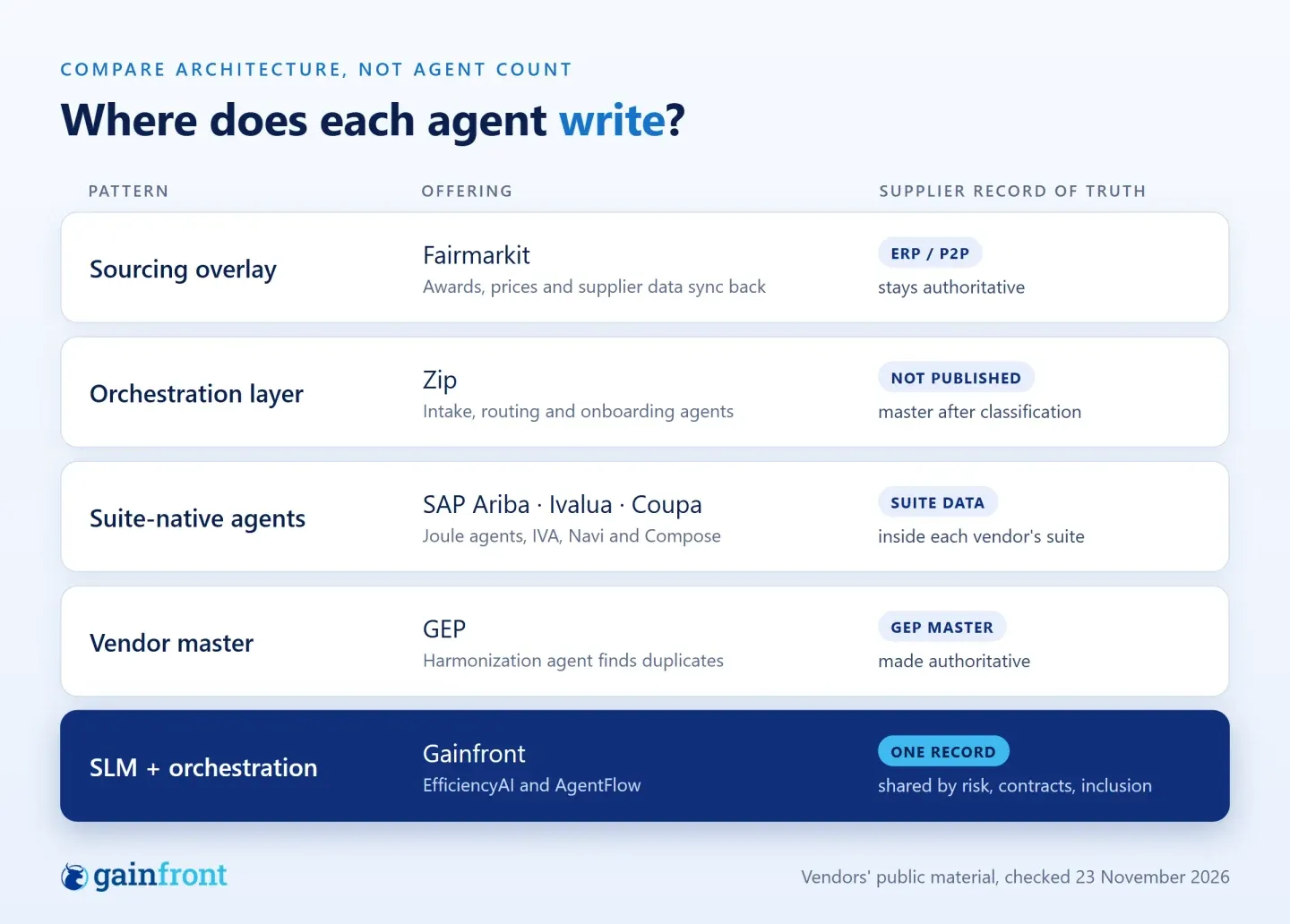
The ROI figures do not compare either. The Hackett Group’s July 2026 benchmarks associate “AI World Class” procurement with up to 3.7× ROI, but that is a benchmark model, not a measured agent result. Zip’s 386% and SAP’s projected 40%–80% time savings come from vendor-commissioned Forrester composites. Ask for finance-validated outcomes on a stated baseline.
What should you ask in an AI agent demo?
- The rebate test. Load two files where the same supplier has different names and IDs. Does the agent merge them, and does the combined spend show up against your contract thresholds?
- The level-4 test. Search for a supplier at level 4 of the taxonomy, such as SEO services rather than marketing. Does the agent return only the suppliers that do that work?
- The alternate-identifier test. Give the agent one commodity under three names from two divisions. Does it map them to one master commodity and show combined spend and the best unit price?
- The exclusion test. Apply an exclusion rule to your diversity reporting base. Can you see exactly which categories and dollars it removed?
- The new-data test. Run a messy transaction the model has never seen. What confidence score or exception path does it produce?
- The write-back test. Take one request from intake through sourcing to write-back. Which systems does the agent read, which does it update, and which stays authoritative? Show it live, not on a slide.
- The audit test. Show the trail for a wrong recommendation: inputs, action, approver, changed record, and how it was corrected.
FAQ
What is the difference between supplier normalization and spend categorization?
Normalization decides which records are the same supplier, for example merging “Acme Industrial LLC” in SAP with “ACME Industrial” in PeopleSoft into one record of truth. Categorization decides what you bought, for example SEO services at level 4 rather than marketing at level 1. Normalization finds savings such as missed rebates and volume tiers. Categorization drives budgeting, forecasting, accountability, and exclusion rules.
How do AI agents find volume discounts in procurement?
They merge duplicate suppliers so total spend is visible against contract thresholds, and they map alternate identifiers to one master commodity so the same item bought under different names is compared on unit price. Gainfront’s EfficiencyAI then ranks the consolidation opportunities for a buyer to act on.
What is the difference between an AI agent and a copilot in procurement?
A copilot helps a person write or read something. An agent takes the next workflow step itself, such as merging duplicate suppliers, categorizing spend, or launching a sourcing event, within rules and approval gates you set.
Can I add AI agents without replacing Coupa or SAP Ariba?
Yes. Gainfront AgentFlow, Zip, and Fairmarkit all work on top of an existing suite. AgentFlow also brings Gainfront’s normalized supplier record and categorization to each decision, with a path to add Gainfront SLM modules later. See the case for coordination over replacement.
How do I compare categorization accuracy across vendors?
Do not compare published percentages. Give every finalist the same extract of your own spend lines, including new suppliers and messy descriptions, and measure accuracy, unclassified spend, duplicate suppliers resolved, and alternate identifiers mapped.
See Gainfront’s AI agents at work
Book a 30-minute AgentFlow demo to see the agents normalize suppliers into one record of truth, categorize spend four levels deep, and flag consolidation and rebate opportunities. Or start a 2 week trial and see onboarding on a supplier record. Or start with the procurement stack scorecard to see whether you should orchestrate or replace. For the wider vendor list, see best AI procurement software 2026. For EfficiencyAI’s launch background, see when SRM meets EfficiencyAI.
Sources
- ISM, “AI-driven spend analytics: from visibility to verified value,” October 2026.
- Supply Chain Management Review / APQC, “What supports accurate spend analysis,” 2024 research.
- Gupta, spend classification study on public purchase lines, arXiv, 21 September 2026.
- Mastercard, “How a state government improved procurement analytics to save $65M,” 2023.
- Gartner, Supply Chain Symposium/Xpo Barcelona day 2 highlights, 19 May 2026.
- Forrester, “AI in procurement: experiment like a teenager,” 30 October 2026.
- The Hackett Group, “AI World Class procurement benchmarks,” 13 July 2026.
- Zip, enterprise solutions, accessed November 2026; Forrester Consulting, Total Economic Impact of Zip, May 2026.
- Coupa, September release announcement, 20 August 2026.
- SAP, Sourcing Assistant and Supplier Management Assistant, 2026; SAP News, “Enabling autonomous spend management with AI-connected processes,” May 2026; Forrester Consulting, projected TEI of SAP Joule, November 2026.
- Ivalua, “Ivalua launches IVA Studio,” 11 June 2026.
- Fairmarkit, “Beyond the copilot: what Total Agentic Sourcing actually looks like,” 29 April 2026; integrations; global manufacturing case study.
- GEP, Quantum Intelligence and supplier master data management, accessed November 2026.